The Challenge
Before Voltr, WELD's creator program faced the same friction that stalls most DTC brands:
- Creator discovery and outreach was costly and time consuming: slow, inconsistent, and capped by founder time.
- Affiliate relationships and content were tracked across disconnected tools and spreadsheets.
- There was no reliable attribution tying creator content to actual Shopify revenue.
- Top-performing organic creator posts were not being amplified into paid ads, leaving the best content upside on the table.
The Results
Across the two month testing period:
| Metric | Result |
|---|---|
| Total revenue growth | 120% over 2 months |
| Highest revenue days ever | 8 record days set |
| Highest revenue month ever | 2 record months set |
| Creator-attributed share under configured rules | 60% of observed revenue |
| Active affiliates added | 500+ |
Interpretation: “120% revenue growth” is WELD's reported total-company result across the stated two-month test, not revenue that Voltr can claim to have caused. Creator attribution reflects the configured identifiers and available connected data; it is not an incrementality estimate.
What Voltr Did
WELD used one connected system for key parts of its creator program: discovery, outreach automation, attribution, and paid-amplification coordination.
Creator discovery and outreach
- Recorded 150,000 in-niche creator outreach opportunities in Voltr workflow logs.
- Recorded 56,000 direct-message and collaboration-invite actions in the test workflow.
- Added more than 500 creators to WELD's affiliate roster; inclusion does not mean every creator generated revenue.
- Collected approximately 1,000 videos mentioning WELD for content review.
AI automated tasks
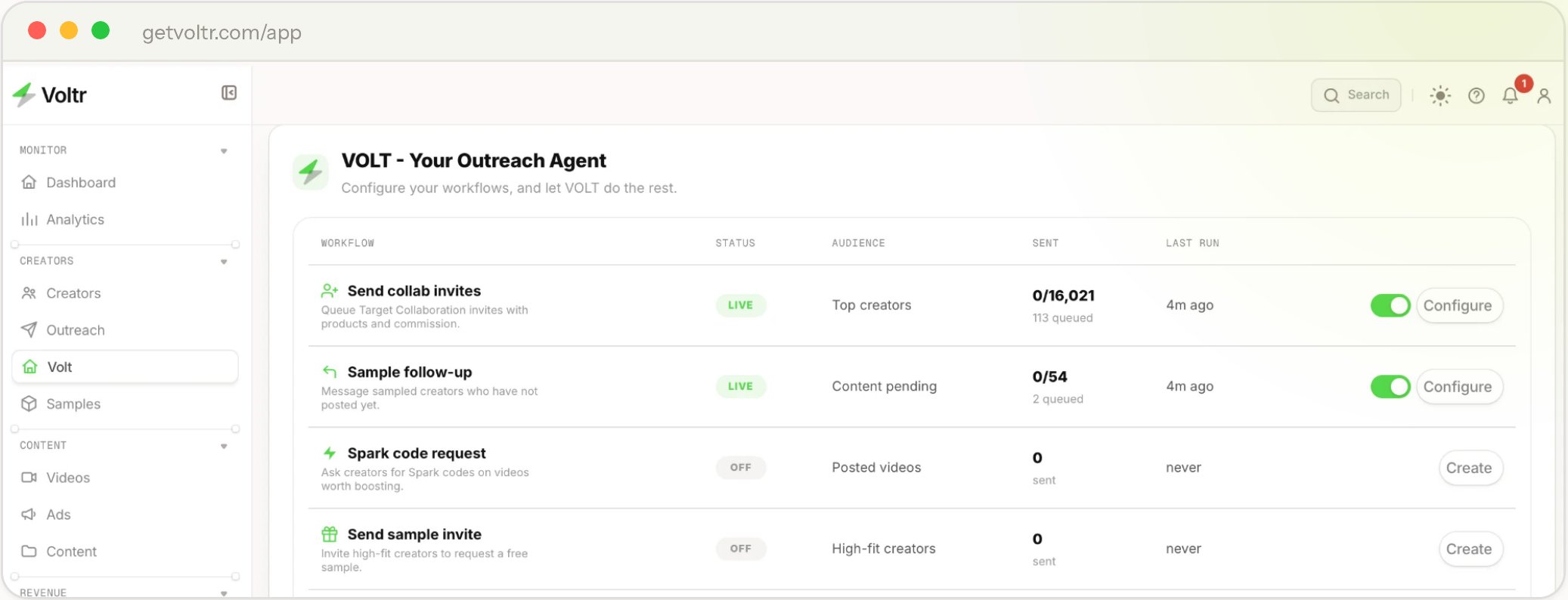
- Used Volt to run outreach and suggest creators in WELD's niche.
- Ran sample follow-ups and content-pending messages automatically. Instead of manually checking who posted, Volt did the heavy lifting.
- Auto-approved samples at set GMV thresholds.
Attribution and amplification
- Associated eligible Shopify orders with creator or post identifiers when connected data and matching rules supported it.
- Surfaced the highest converting content drivers and put them on automated payout retainers through Voltr.
- Coordinated 45 creator posts for Meta advertising workflows.
- WELD's TikTok Shop reporting showed more than $35,000 in GMV for the referenced campaign.
Overview
WELD is a protein energy drink brand with 18g protein, 200mg caffeine, and zero sugar, built for high-performing consumers. Like most DTC brands, WELD was running its creator program across multiple platforms: discovery took time, affiliates were managed across spreadsheets and Discord, and there was no clean line from a creator post to actual revenue.
Voltr is a creator commerce platform built to connect that work. It brings TikTok, Meta, and Shopify workflows into one operating view across creator discovery, outreach, affiliate management, available attribution, content review, and paid-amplification coordination. WELD became Voltr's first live test: the founder running his own platform on his own brand.
Over a two month testing window, WELD grew revenue by 120%, posting its eight highest revenue days and its single highest revenue month on record.
Methodology and limitations
- Study design: observational, related-party case study covering a two-month Voltr testing window. It was not a randomized or controlled experiment.
- Revenue evidence: 120% growth and the record-day and record-month statements were reported from WELD's internal business records. The exact dates, baseline amount, margin, refunds, and comparison-period details are not published here.
- Workflow evidence: outreach, roster, content, and advertising activity figures were reported from Voltr and connected-platform workflow logs.
- Attribution: creator-associated revenue depends on connected sources, identifiers, the selected window, matching, and deduplication. It does not observe every touchpoint.
- Causation: other changes in product, offer, inventory, seasonality, organic demand, advertising, or operations may have contributed to WELD's result. This case cannot isolate their effects.
- Review date: claims and wording on this page were reviewed by the Voltr product team on August 5, 2026.
In the Founder's Words
"I built Voltr because I needed it for my company WELD. Running it on my own brand, we hit our best revenue days ever and our highest month on record, 120% growth in two months. I'm not selling a tool I haven't run myself."Jake Elbeery, Founder of Voltr · CMO of WELD
Why this matters for your brand
WELD's experience shows how a team can connect creator discovery, outreach, available attribution, and paid-amplification coordination instead of running those tasks across disconnected tools. The result is one related-party example, not a guaranteed outcome.
If you run creators across TikTok Shop, Meta, and Shopify, evaluate whether Voltr can make the workflow and its evidence easier to operate.